
September 16, 2026
Bring Kids Back UA at PACE hearing: Russia has built a system to deport, indoctrinate and militarize Ukrainian children
On 16 September in Paris, the PACE Parliamentary Network on the situation of the children of Ukraine held a hearing on the return of deported and forcibly transferred Ukrainian children and accountability for those responsible. Participants included representatives of the President of Ukraine’s Bring Kids Back UA initiative, Ukrainian authorities, the United Nations, the OSCE Moscow Mechanism and the International Criminal Court. Speakers presented evidence of systemic violations of the rights of Ukrainian children and discussed how to speed up their safe return and hold perpetrators accountable.
Bring Kids Back UA intervention
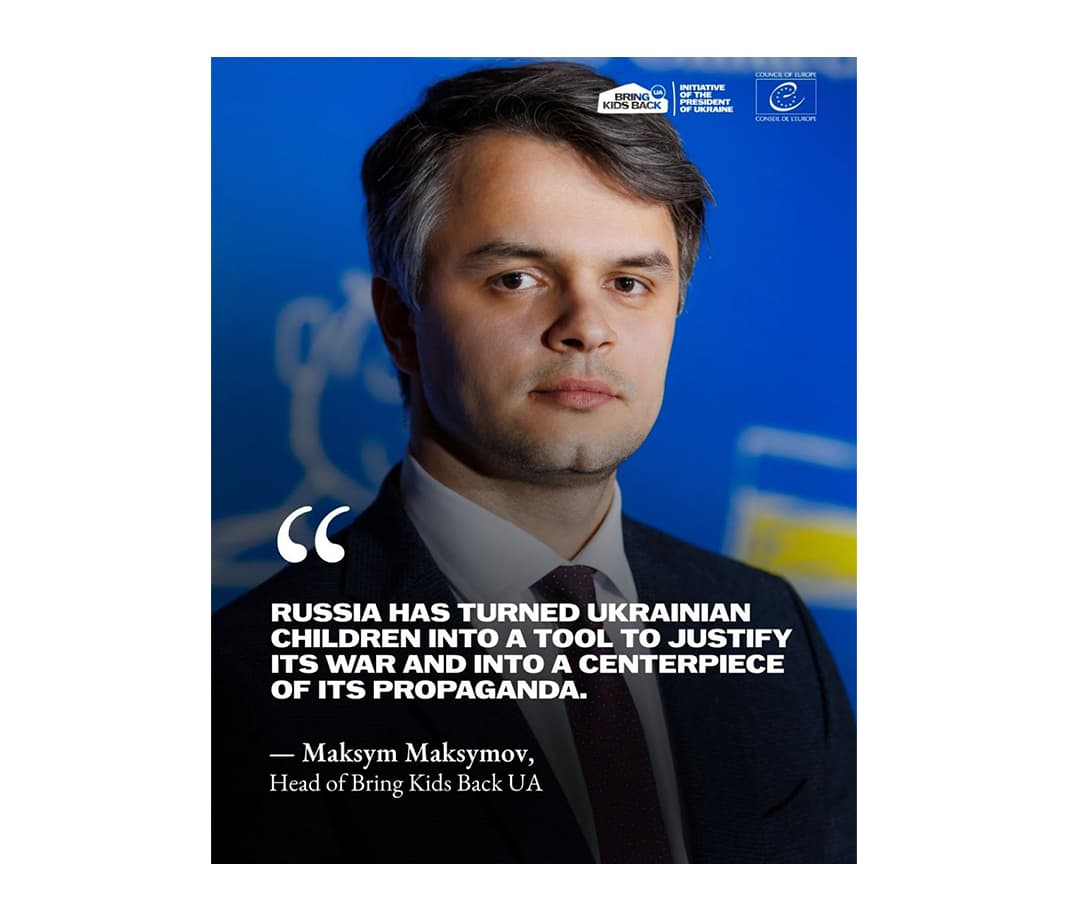
Maksym Maksymov, Head of Bring Kids Back UA, spoke on the first panel, which examined progress and obstacles in turning international commitments on Ukrainian children into action. He reminded parliamentarians that Russia has been taking Ukrainian children since 2014, and that the scale of this policy has grown dramatically since the full-scale invasion.
“Russia has turned Ukrainian children into a tool to justify its war and into a centerpiece of its propaganda. It calls the killing and maiming of children ‘rescue.’ It calls the destruction of schools and hospitals ‘denazification.’ What we need to look at, however, is not what Russia says, but what it does. It takes children from their families. It moves them deep into its territory. It forces Russian citizenship on them. It erases their names, their language, their identity. And it prepares them for its army. Each part supports the next. Together, as documented by the distinguished experts of the OSCE Moscow Mechanism, these elements form a system of purposeful design. And now – I believe – it falls to us to decide how soon this policy is named for what it is in law, and how soon those who design it and those who carry it out are held to account,” said Maksym Maksymov.
According to Maksymov, the same policy of indoctrination and militarization reaches children in the temporarily occupied territories. Military training, drone operation and membership in Russian militarized youth groups are becoming part of everyday schooling, while textbooks deny the existence of Ukraine, its language and its culture.
Maksymov stressed that one of the key tasks now facing the international community is to build a single accountability pathway: from establishing the fate of each child to proving a state policy and identifying those who design, finance, organize and carry it out.
Other speakers
Vanessa Frazier, UN Under-Secretary-General and Special Representative of the Secretary-General for Children and Armed Conflict, delivered the keynote address. She set out her assessment of clear and grave violations of the rights of Ukrainian children by the Russian Federation, affecting children who have been deported or forcibly displaced, children in the temporarily occupied territories, and children living under the aggression against their country. She commended Ukraine’s determination to keep children in school despite all the challenges and stressed that identifying and tracking the children who have been taken is essential for their return and reintegration.
Daria Herasymchuk, Commissioner of the President of Ukraine for Children’s Rights and Child Rehabilitation and Ukraine’s National Focal Point on Children and Armed Conflict, called for strong and swift international action in response to this policy.
Kateryna Rashevska, Legal Expert and Lead on International Justice and Legal Analysis at the Regional Center for Human Rights, joined the first panel online.
The second panel focused on documentation, accountability and international monitoring, including the 2026 findings of the OSCE Moscow Mechanism on the indoctrination and militarization of Ukrainian children and the ongoing investigations of the International Criminal Court. Speakers included Dr Elīna Šteinerte, expert on the OSCE Moscow Mechanism missions in 2023, 2024 and 2026, and Alexis Demirdjian, Head of the Ukraine Unified Team at the ICC Office of the Prosecutor. They underlined the need to preserve and share evidence, support national and international investigations, enforce accountability mechanisms, and ensure that the harm caused by forced identity change, indoctrination and militarization is properly recognized.
Closing the hearing, Network Vice-Chair Miapetra Kumpula-Natri (Finland) urged parliamentarians to take the hearing’s messages back to their national parliaments and push for concrete measures to bring the children home, ensure accountability, and partner with Ukraine in supporting its young people.