
September 29, 2026
Canada and Norway have announced additional financial support for Ukraine
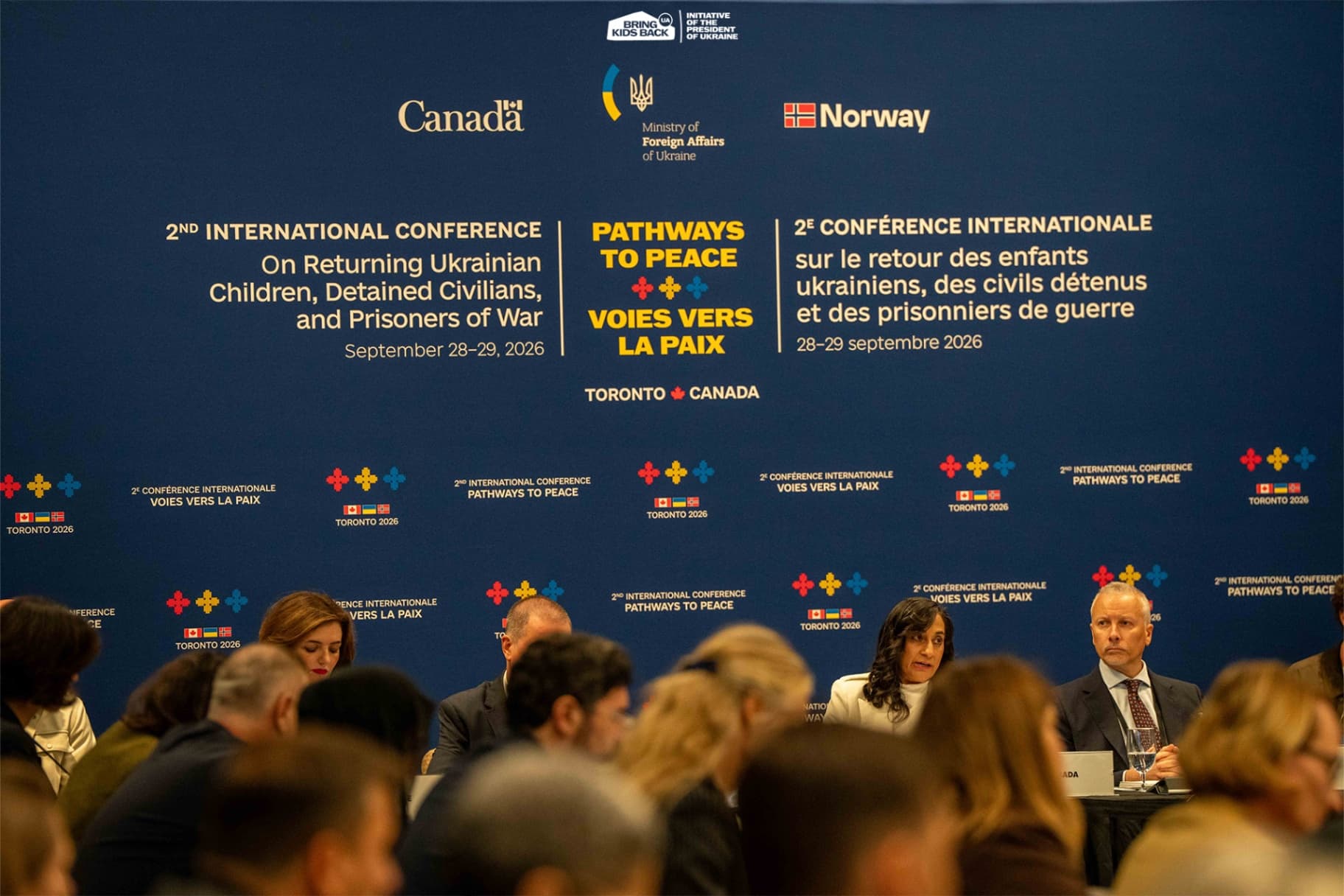
Yesterday, 83 delegations, representing 72 states and 11 international organizations, arrived in Toronto for Pathways to Peace: Second International Conference on Returning Ukrainian Children, Detained Civilians and Prisoners of War. The conference builds on the work launched in Montreal in 2024 and complements the International Coalition for the Return of Ukrainian Children, co-chaired by Ukraine and Canada. Delegates heard testimonies from Ukrainians who survived occupation and captivity, as well as national statements by states and international organizations.
Canada’s Minister of Foreign Affairs Anita Anand drew delegates’ attention to the “Empty Chairs” installation next to the plenary room: three empty chairs with personal items represent prisoners of war, unlawfully detained civilians and deported children.
“These chairs are empty. They are children, parents, sons, daughters, husbands, wives. Families are still waiting for them,” said Anand. The Minister announced more than CAD 860,000 in new funding, in addition to the CAD 6 million announced earlier this month by Prime Minister of Canada Mark Carney.
“Sanctions and funding are not ends in and of themselves. They are tools, with the sole objective of bringing Ukrainian children, detained civilians and prisoners of war home. It’s about what we do with those commitments going forward: finding the missing, confronting the abuses that Russia has committed, opening pathways home, reuniting families,” she stressed.
Eivind Vad Petersson, State Secretary at the Norwegian Ministry of Foreign Affairs, announced additional Norwegian funding to UNICEF and the ICRC totalling approximately USD 25 million.
“The fate of deported Ukrainian children and the release of unlawfully detained civilians and prisoners of war are not only humanitarian concerns. They are matters of international humanitarian law, of international human rights law and of accountability. They also have direct implications for any just and lasting peace,” he said. According to Petersson, the effectiveness of the international community’s response will be measured by results: whether missing persons are located, whether people are returned home, and whether they receive the support they need.
Minister of Foreign Affairs of Ukraine Andrii Sybiha said in a video address that Ukraine is working on a UN General Assembly resolution addressing the torture of Ukrainian prisoners held by Russia.
“The human dimension must be central to every effort to reach a settlement. The release of our people, all of them, is a key checkpoint on any path to peace,” he said.
Denys Uliutin, Minister of Social Policy, Family and Unity of Ukraine, noted that in the two years since Montreal, the number of Ukrainians registered as missing has grown from around 42,000 to more than 114,000. Ukrainian authorities are aware of more than 300 places of detention holding Ukrainians in Russia, Belarus and the occupied territories, and the ICRC has access to none of them. In June, the Ukrainian Parliament Commissioner for Human Rights handed the Russian side and the President of the ICRC a list of civilians who must be released first. Among them are 225 people over the age of 60 and 276 people detained even before the full-scale invasion. Russia has not replied.
“Ukraine is not asking for sympathy. We are asking for three things: access, information and return,” said Uliutin.