
October 7, 2026
Russia has built a system to militarize Ukrainian children: witnesses from the occupied territories address OSCE parliamentarians in Andorra
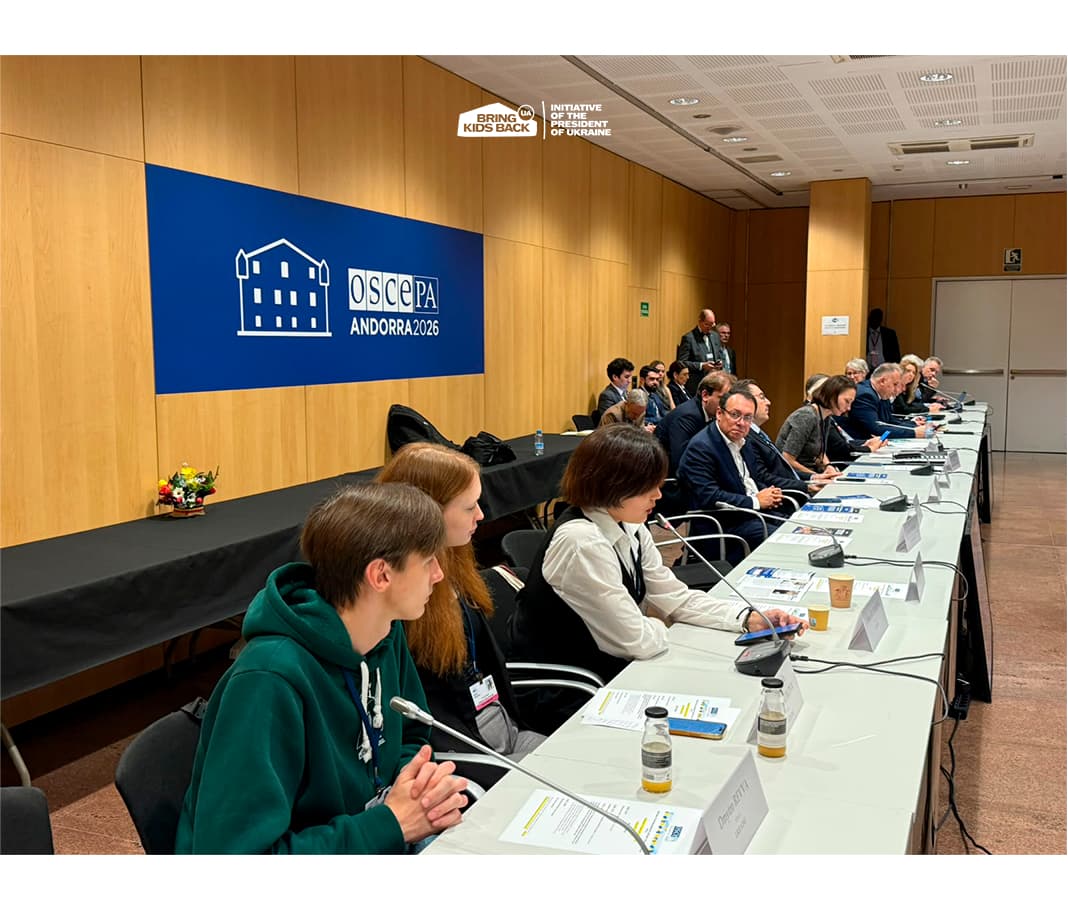
The meeting of the Parliamentary Support Team for Ukraine took place as part of the 24th Autumn Meeting of the OSCE Parliamentary Assembly
Andorra la Vella, 7 October 2026. Today, as part of the 24th Autumn Meeting of the OSCE PA, the Parliamentary Support Team for Ukraine (PSTU) held a meeting. The meeting opened with remarks by PSTU Chair Nancy Faeser, followed by a situation update from OSCE PA Vice-President and PSTU Co-Chair Mykyta Poturaiev. Its thematic discussion focused on Russia's crimes against Ukrainian children: deportation and forcible transfer, indoctrination and militarization. Parliamentarians heard from Maksym Maksymov, Head of Bring Kids Back UA, an initiative of the President of Ukraine, and Yevheniia Kravchuk, Member of the Verkhovna Rada of Ukraine. Witnesses Dmytro, Viktoriia and Polina also spoke. They are victims of Russian crimes who grew up under occupation and managed to get out.
Witnesses: “Silence under occupation does not mean consent”
Dmytro grew up in occupied Khrestivka in Donetsk Oblast. He described how Ukrainian language and literature disappeared from the school curriculum and how what people were allowed to say gradually changed. He was stopped for not having a Russian passport, and his phone was checked. Representatives of Russian security services searched and threatened him, and representatives of the occupation authorities beat him. He had to leave through Russia. At a checkpoint, he was threatened with a stun gun and forced to delete personal photos and to record a video in which he had to say that he supported Russia and did not support Ukraine. Dmytro spent about two years in Germany, where he helped organize public actions in support of Ukrainian prisoners of war. In December 2025, he returned to Ukraine and now lives in Kyiv.
“Silence under occupation does not mean consent. Words spoken under threat are not a free choice. I was forced to say on camera that I do not support Ukraine. Today I can say what I truly believe: Ukraine is my country. Khrestivka is my home,” said Dmytro.
Viktoriia was 11 when the occupation of her hometown of Bakhchysarai began. Before 2014, she attended a Ukrainian school. After the occupation, her favourite teachers left Crimea and Ukrainian disappeared from her school. Yunarmiya appeared instead: her classmates were taught to assemble and disassemble a rifle and to march. Access to social media and independent media was gradually blocked. When she studied journalism, students were required to produce materials praising the occupation of Crimea and later the war against Ukraine. After the full-scale invasion began, Viktoriia left through Russia and Belarus. At every border she was taken for additional questioning because her documents listed her place of birth as Crimea, Ukraine. She now lives in Kyiv. People from the occupied territories write to her, asking how to leave and how to start a new life.
“When we say, ‘Why don't we just give up these territories?’, we are not talking only about land. We are talking about the people who will remain there. About children who will continue to grow up in the system I have described,” Viktoriia stressed.
Polina was eight when her hometown of Kerch was occupied. She said that any opinion connected with Ukraine could lead to being called to the principal's office, and some children were taken to the police. The school psychologist explained to her how she was supposed to think and which side she was supposed to be on. After the full-scale invasion, “Conversations About Important Things” appeared in schools, where teachers openly expressed hatred towards Ukraine. Students were forced to write letters to Russian soldiers, and the soldiers themselves came into classrooms. Her classmates were expected to register with a Russian military enlistment office after graduation. Polina also described the growing number of political prisoners, searches and interrogations among the people around her. In 2025, she decided to leave.
“The most frightening part was watching children start to believe it. Because if you repeat the same lie to a child for years, at some point they stop seeing it as propaganda. For them, it simply becomes the world. I did not want to leave Crimea. I wanted to leave the occupation,” said Polina.
Bring Kids Back UA extends special thanks to Yevheniia Kravchuk, Member of the Verkhovna Rada of Ukraine, and Mykyta Poturaiev, OSCE PA Vice-President and PSTU Co-Chair, for their participation in the meeting and their support for the return of Ukrainian children.