
September 29, 2026
Statements by Delegations at the International Conference Pathways to Peace
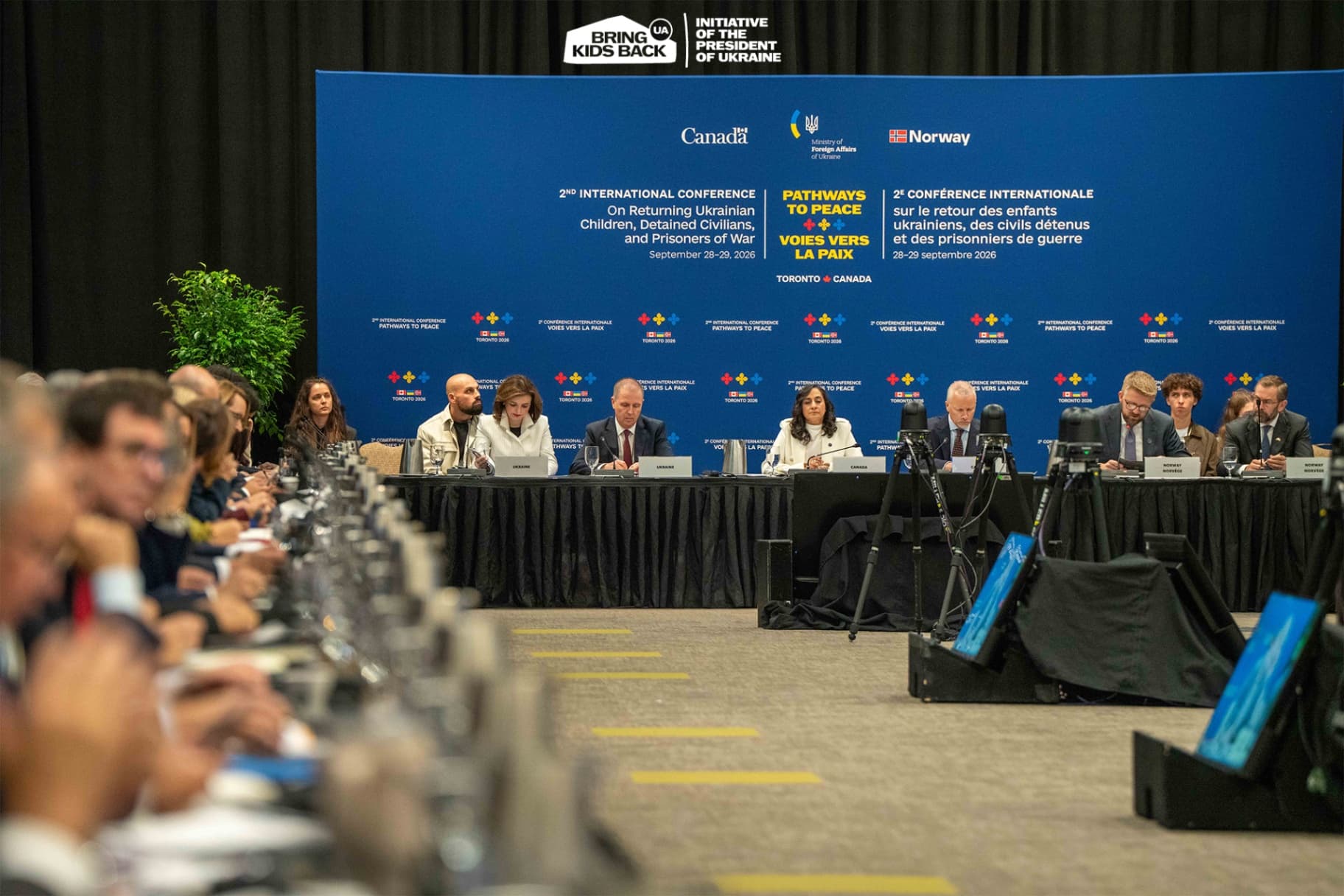
The international conference Pathways to Peace, co-hosted by Canada, Norway and Ukraine, opened on 28 September. Key outcomes of the first day include new EU sanctions against 27 individuals and entities involved in the deportation of Ukrainian children, as well as additional funding from Canada and Norway for the search, return and reintegration of children.
The European Union imposed sanctions on 27 more individuals and entities involved in the deportation, forcible transfer, “re-education” and indoctrination of Ukrainian children. European Commissioner Dubravka Šuica also confirmed the EU’s endorsement of the conference’s joint communiqué. Last week, Australia also introduced new sanctions, including against those involved in the abduction, indoctrination and militarization of Ukrainian children.
Canada will direct the new CAD 860,000 to two areas. CAD 500,000 will go to the All Survivors Project Foundation to strengthen services for survivors of conflict-related sexual violence. CAD 363,000 will go through the Canada Fund for Local Initiatives to Ukrainian civil society organizations supporting returned civilians and their families, families of prisoners of war and returned children. Anand also detailed the allocation of the CAD 6 million announced earlier: CAD 2 million will go to UNICEF for reintegration services for children, and CAD 4 million to partners working to trace and return children and to counter indoctrination, militarization and recruitment. Japan decided to support the Council of Europe Consultation Group on the Children of Ukraine.
The United Kingdom proposed extending the approach partners have built around children to unlawfully detained civilians. “We should bring the same solidarity, coordination and profile that we have together so successfully brought to the issue of stolen Ukrainian children to the issue of Ukrainian civilian detainees,” said Stewart Wood, UK Parliamentary Under-Secretary of State at the Foreign, Commonwealth and Development Office.
The OSCE Parliamentary Assembly welcomed plans by Ukraine’s Permanent Representative in Vienna to establish a Group of Friends of the International Coalition for the Return of Ukrainian Children there, giving the Coalition a standing presence within the OSCE diplomatic community. The OSCE called on states involved in negotiations or mediation on exchanges to include Vadym Golda, Maxim Petrov and Dmytro Shabanov on all release lists.
Several delegations reported on concrete work on return and reintegration:
Latvia. This year, Latvian funding helped Save Ukraine return 15 children. Latvia also stated its readiness to serve as a safe route for the return of deported children.
Lithuania. The country has fulfilled its Montreal commitment to serve as a transit country for Ukrainians returning home. Lithuania is directing more than EUR 10 million to support children, including projects by Ukrainian civil society organizations on the search for and return of children and on documenting crimes.
The Netherlands. Contributed EUR 2 million to the ICMP to find missing persons, including abducted children, in cooperation with the Office of the Ombudsman. The Netherlands also supports a UNDP project that uses DNA to establish the family links of deported children.
Spain. Ready to extend its psychological support and specialized medical training program to returned children. Spain is also implementing a health program for former prisoners of war.
Reintegration. UNICEF and its partners have reached almost 1,600 returned children and young people with reintegration services. France, together with UNICEF, funded two child protection centers in Kharkiv and Dnipro, with a third to open soon. Belgium will build seven shelters in Ukrainian schools.
The Council of Europe announced a new Action Plan for Ukraine for 2027–2030, with the rights and future of children at its heart.
Upcoming conferences. Estonia will host the Ukraine Recovery Conference in Tallinn on 28–29 January 2027, with the human dimension as one of its central pillars. Croatia and Ukraine are preparing the second International Conference on the Reintegration of Ukrainian Veterans, planned for April 2027.
German Ambassador to Canada Matthias Lüttenberg drew attention to the situation in occupied Oleshky. “We are gravely concerned about the Russian-provoked humanitarian crisis in Oleshky. Since May 2026, Russia has effectively used starvation as a weapon by blocking all humanitarian corridors, trapping thousands of civilians amid constant shelling and extreme deprivation, including many children,” he said.
Nikolaus Marschik, Secretary General of the Austrian Foreign Ministry, said Austria fully supports Bring Kids Back UA and will continue to support such initiatives financially. “As of January 2027, Austria will have a seat on the UN Security Council as a non-permanent member. We will continue our focus on children in armed conflict. Thereby, we can make sure that the issue of abducted Ukrainian children will stay highly visible on the international agenda,” he said.
Danielle Bell, Head of the UN Human Rights Monitoring Mission in Ukraine, said the UN Human Rights Office has interviewed 950 Ukrainian prisoners of war. More than 95% of them described systematic torture, ill-treatment and sexual violence.
The EU, Austria, France, Luxembourg, Finland, Albania and Andorra expressed their support for Bring Kids Back UA.
National statements were delivered by representatives of Albania, Andorra, Antigua and Barbuda, Argentina, Australia, Austria, the Bahamas, Belgium, Bosnia and Herzegovina, Chile, Costa Rica, Croatia, Cyprus, Denmark, Estonia, Finland, France, Germany, Ghana, Greece, Honduras, Hungary, Iceland, Ireland, Italy, Japan, Latvia, Lithuania, Luxembourg, Moldova, Montenegro, the Netherlands, North Macedonia, Qatar, Slovenia, South Africa, Spain, Sweden, Switzerland, Türkiye and the United Kingdom. Statements were also delivered by the European Union, the Council of Europe, the OSCE Parliamentary Assembly, the OSCE, the Special Representative of the UN Secretary-General on Sexual Violence in Conflict, the International Commission on Missing Persons (ICMP), the Office of the UN High Commissioner for Human Rights and UNICEF.