
October 1, 2026
Toronto Pledge: 54 States and International Organizations Endorse Joint Steps to Return Ukrainian Children, Civilians, and Prisoners of War
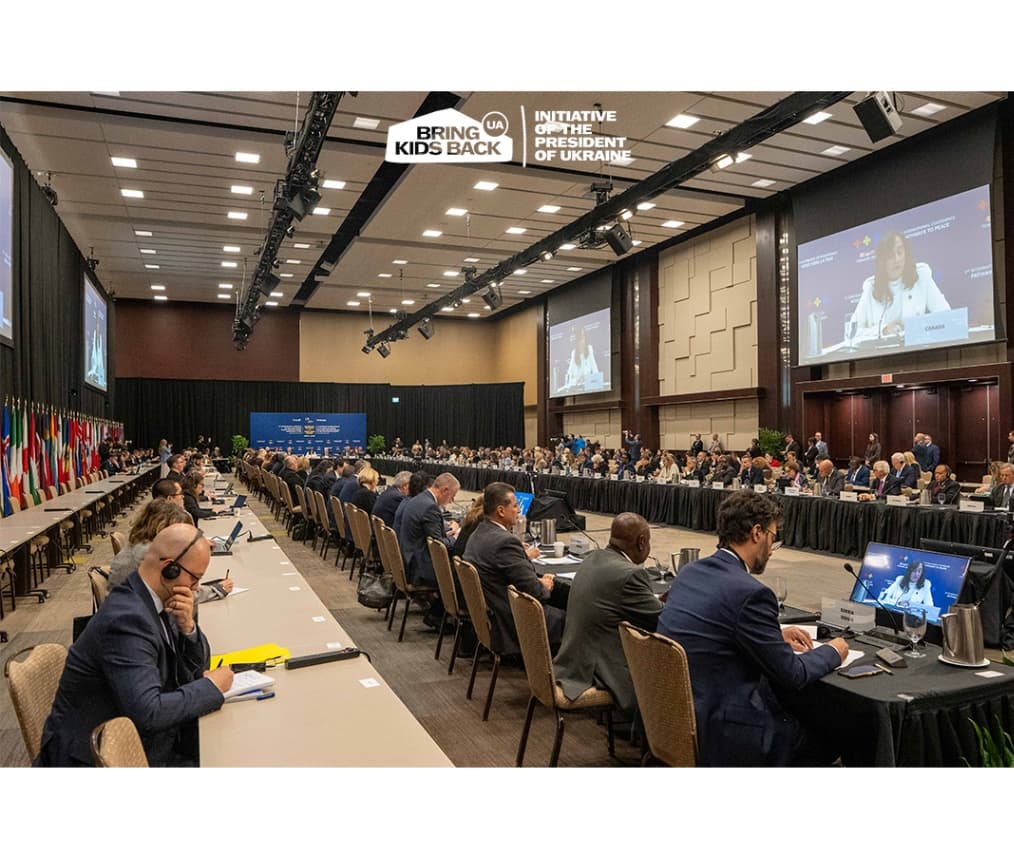
Toronto hosted Pathways to Peace: the Second International Conference on Returning Ukrainian Children, Detained Civilians, and Prisoners of War. Its outcomes include Honduras joining the International Coalition for the Return of Ukrainian Children, new EU and Canada sanctions against those involved in the deportation of Ukrainian children, approximately USD 25 million from Norway, and nearly CAD 7 million from Canada for tracing, return, and reintegration.
TORONTO, October 1, 2026. On September 28–29, 2026, Toronto hosted Pathways to Peace: the Second International Conference on Returning Ukrainian Children, Detained Civilians, and Prisoners of War, co-hosted by Canada, Ukraine, and Norway. The event brought together 83 delegations: 72 states and 11 international organizations.
On the first day, delegates heard testimonies from Ukrainians who survived occupation and captivity: Daria and Matvii, who grew up in occupied Crimea and went through Russia's militarized education system; Yulian, a Marine and defender of Mariupol who spent two and a half years in Russian captivity; and Margarita Shabanova, whose husband, Dmytro Shabanov, a staff member of the OSCE Special Monitoring Mission, has been unlawfully held by Russia since April 2022. National statements by the delegations followed.
On the second day, three closed thematic sessions took place: on returning Ukrainian children (chaired by Canada), on unlawfully detained civilians (chaired by Norway), and on prisoners of war (chaired by Ukraine). Their outcomes were presented at the closing plenary session.
The conference built on the work launched in Montreal in 2024 at the Ministerial Conference on the Human Dimension of Peace. Delegations were to assess what has changed since then and agree on concrete next steps to bring home deported and forcibly transferred children, unlawfully detained civilians, and prisoners of war.
“What is written in the Joint Communiqué matters, and Ukraine supports it. But a communiqué is a description of intentions, and a description of intentions does not bring people home. For the two days of the conference, an empty chair stood next to the podium. It is a symbol of a person — a child, a civilian, a soldier — held by Russia and still waiting to come home. There is one chair. But there are hundreds of thousands of such people. If we set a chair for each of them, we would probably fill an entire city. Toronto will be remembered not for the text we adopt today, but for how many of these chairs will no longer stand empty when we meet again,” said Denys Uliutin, Minister of Social Policy, Family and Unity of Ukraine.
“The true measure of diplomatic success is people who have come home from Russian captivity. That is what brought us to Toronto, where 83 delegations discussed ways to return Ukrainian children unlawfully deported by Russia, arbitrarily detained civilians, and prisoners of war. Thousands of families are waiting for them at home. We thank Canada and Norway for co-chairing, and all our partners for their readiness to work toward this result together with Ukraine,” noted Mariana Betsa, Deputy Minister of Foreign Affairs of Ukraine.
“Two years ago, more than 60 delegations gathered in Montreal; in Toronto, there were already 83. Over this time, the International Coalition for the Return of Ukrainian Children has grown from 40 to 52 countries and international organizations. These figures speak for themselves: the international community increasingly recognizes that a just and lasting peace is impossible without the return of Ukrainian children, unlawfully detained civilians, and prisoners of war. We thank everyone who stands shoulder to shoulder with us in this fight,” said Maksym Maksymov, Head of the President of Ukraine's initiative Bring Kids Back UA.
Key Outcomes
Participants identified coordinated steps to implement UN General Assembly resolution A/RES/ES-11/9 on the return of Ukrainian children, adopted on December 3, 2025.
Two more countries joined the Safe Pathways Home initiative, allowing their territory to be used for transit to rescue Ukrainians.
Norway announced approximately USD 25 million for the International Committee of the Red Cross and UNICEF. The funds will support family contact, tracing of missing persons, and legal and psychosocial assistance.
Canada allocated more than CAD 800,000 in additional funding, including CAD 500,000 to support survivors of conflict-related sexual violence and CAD 363,000 for local civil society initiatives assisting returnees and their families. This comes in addition to CAD 6 million announced earlier this month, of which CAD 2 million will go to UNICEF for the reintegration of returned children and CAD 4 million to tracing and return efforts and to countering Russia's indoctrination and militarization of children.
The European Union adopted sanctions against 10 individuals and 17 entities involved in the deportation, forcible transfer, and forced assimilation of Ukrainian children, including through indoctrination and militarized education.
Canada imposed new sanctions on 8 individuals involved in violations of the rights of Ukrainian children, including their unlawful deportation and forcible transfer.
Participants finalized the 2026–2027 Forward-Looking Agenda of the International Coalition for the Return of Ukrainian Children. The document sets out shared priorities for tracing children, ensuring their safe return and reintegration, and holding perpetrators accountable. Countering the Russification, indoctrination, and militarization of Ukrainian youth in the temporarily occupied territories has become a cross-cutting focus of the Coalition's work.
Honduras joined the International Coalition for the Return of Ukrainian Children, which now has 52 members.
Following the conference, a Joint Communiqué endorsed by 54 delegations was published. Its central part, the Toronto Pledge, commits to three things: finding Ukrainians whom Russia forcibly took from their homes, bringing them home, and supporting their recovery.