
October 16, 2026
Ukraine’s Parliament and Bring Kids Back held expert meetings with members of Parliament
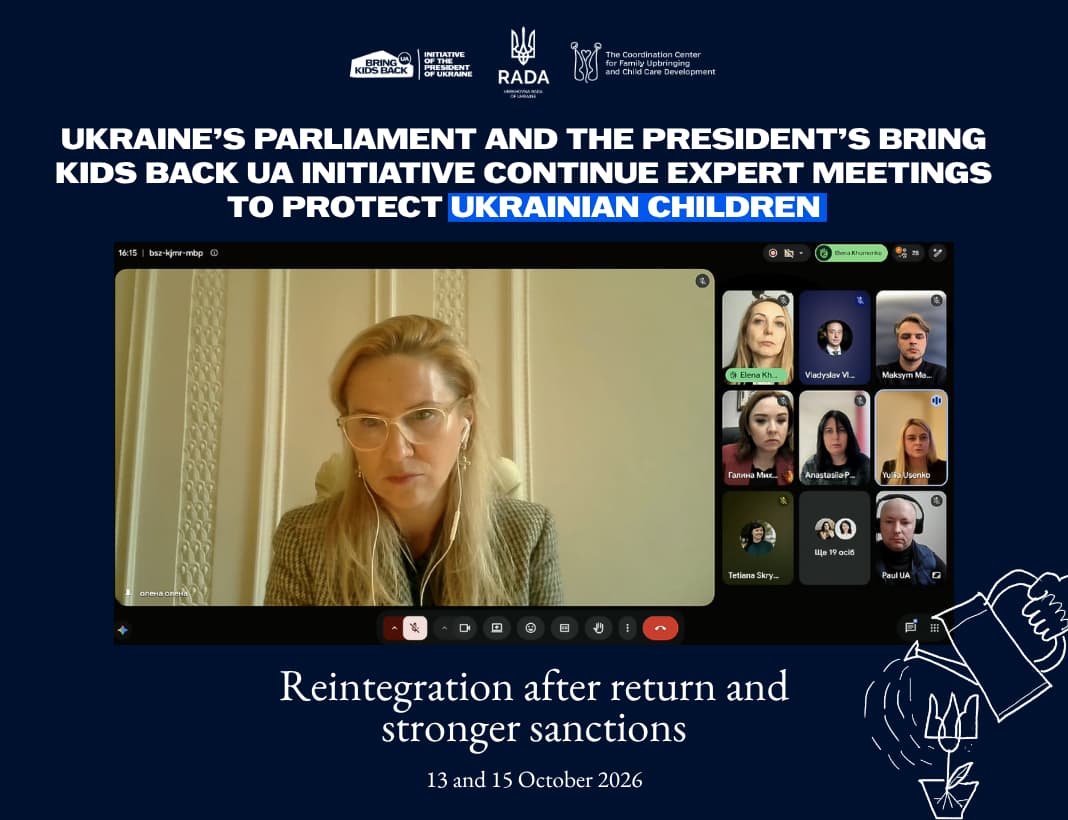
Ukraine’s Parliament and President of Ukraine’s Bring Kids Back UA Initiative held expert meetings with members of parliament on 13 and 15 October to strengthen joint efforts to bring Ukrainian children home, support their reintegration, and ensure accountability for crimes committed against them.
On 13 and 15 October, further meetings were held במסגרת the platform established by Olena Kondratiuk, Deputy Chair of the Verkhovna Rada of Ukraine, together with Bring Kids Back UA.
On 13 October, participants discussed the outcomes of the conference in Toronto and the reintegration of children and young people following their return from deportation and occupation.
Specialists assess each child’s needs and develop an individual support plan. This may include psychological and medical assistance, restoration of documents, temporary housing, a return to education, and support to address learning losses. For young people, vocational training and employment opportunities are also important. Psychologists work not only with children but also with their parents and guardians, helping families adapt after their return. Long-term support is intended to ensure access to the necessary services in the community where the child will live.
“Since 2023, we have been working to ensure that every child and young person receives support tailored to their needs after returning. Our goal is to integrate this support into public policy and the state service system, introduce a unified standard for reintegration support, and develop a network of service providers in local communities. This will make it possible to provide systematic support to children and young people regardless of where they live,” said Kyrylo Lapko, Deputy Head of the Coordination Centre for Family Upbringing and Child Care Development.
The participants also discussed preparations for piloting reintegration and support services in local communities. Practical obstacles include a shortage of housing and delays in restoring Ukrainian documents, which complicate access to education, healthcare, and financial assistance. Participants agreed to continue exploring legal mechanisms for restoring documents and discussed involving the State Migration Service in a dedicated meeting.
On 15 October, discussions focused on sanctions policy: how to align partners’ decisions, increase pressure on those responsible for crimes against children, and use parliamentary diplomacy to advance these efforts.
“An analysis of seven key jurisdictions shows that only 5% of individuals sanctioned for crimes against Ukrainian children appear on all lists simultaneously. Meanwhile, 42% of those included on Ukraine’s sanctions list are entirely absent from the lists of our international partners. Together with members of parliament and Bring Kids Back UA, we agreed to intensify and coordinate joint efforts to harmonise sanctions lists among Ukraine, the EU, the United Kingdom, and other member states of the Council of Europe in relation to crimes against Ukrainian children. The creation of such a unified list is envisaged in PACE resolutions. We will also raise this issue during the debates on the indoctrination and militarisation of Ukrainian children planned at the European Parliament this year,” said Olena Kondratiuk, Deputy Chair of the Verkhovna Rada of Ukraine.
“Coordinated efforts are translating into concrete sanctions decisions. Ahead of the meeting of the International Coalition for the Return of Ukrainian Children in Brussels, Ukraine shared with its partners a consolidated list compiled using information from government institutions and non-governmental organisations. This helped bring partners’ sanctions decisions closer together. At the conference in Toronto, the European Union and Canada announced new sanctions packages targeting crimes against Ukrainian children. Together with parliamentarians, governments, and civil society organisations, we must continue pushing for new measures so that sanctions cover more individuals involved in these crimes, are implemented in more countries, and genuinely restrict the ability of those who organise and commit them to operate. Everyone involved must be identified and held accountable,” said Maksym Maksymov.
Sanctions efforts must target the organisers, perpetrators, and those financing these practices, complementing the search for and return of children, humanitarian efforts, and the pursuit of justice.
“Violations of Ukrainian children’s rights do not end with deportation. Russia severs their ties with their families and Ukraine, imposes a Russian identity on them, and involves them in military training. That is why it is important to address the full scope of these violations on international platforms, including indoctrination and militarisation. Parliamentarians can engage directly with their counterparts in other countries, help keep these issues on the political agenda, and strengthen international pressure. Our shared goal is to bring every Ukrainian child home and ensure that no violation of their rights committed by Russia goes unpunished,” said Yuliia Usenko, Head of the Accountability Division at Bring Kids Back UA.
“Sanctions for crimes against Ukrainian children must remain high on the political agenda. Members of parliament can strengthen these efforts by making use of parliamentary diplomacy,” said Vladyslav Vlasiuk, Adviser and Presidential Commissioner for Sanctions Policy.
The next steps include consolidating existing sanctions lists from different countries to assess their alignment, identify gaps, and determine where restrictions could have the greatest impact. Work will also continue on support for children and young people after their return and on providing information to support parliamentary advocacy.